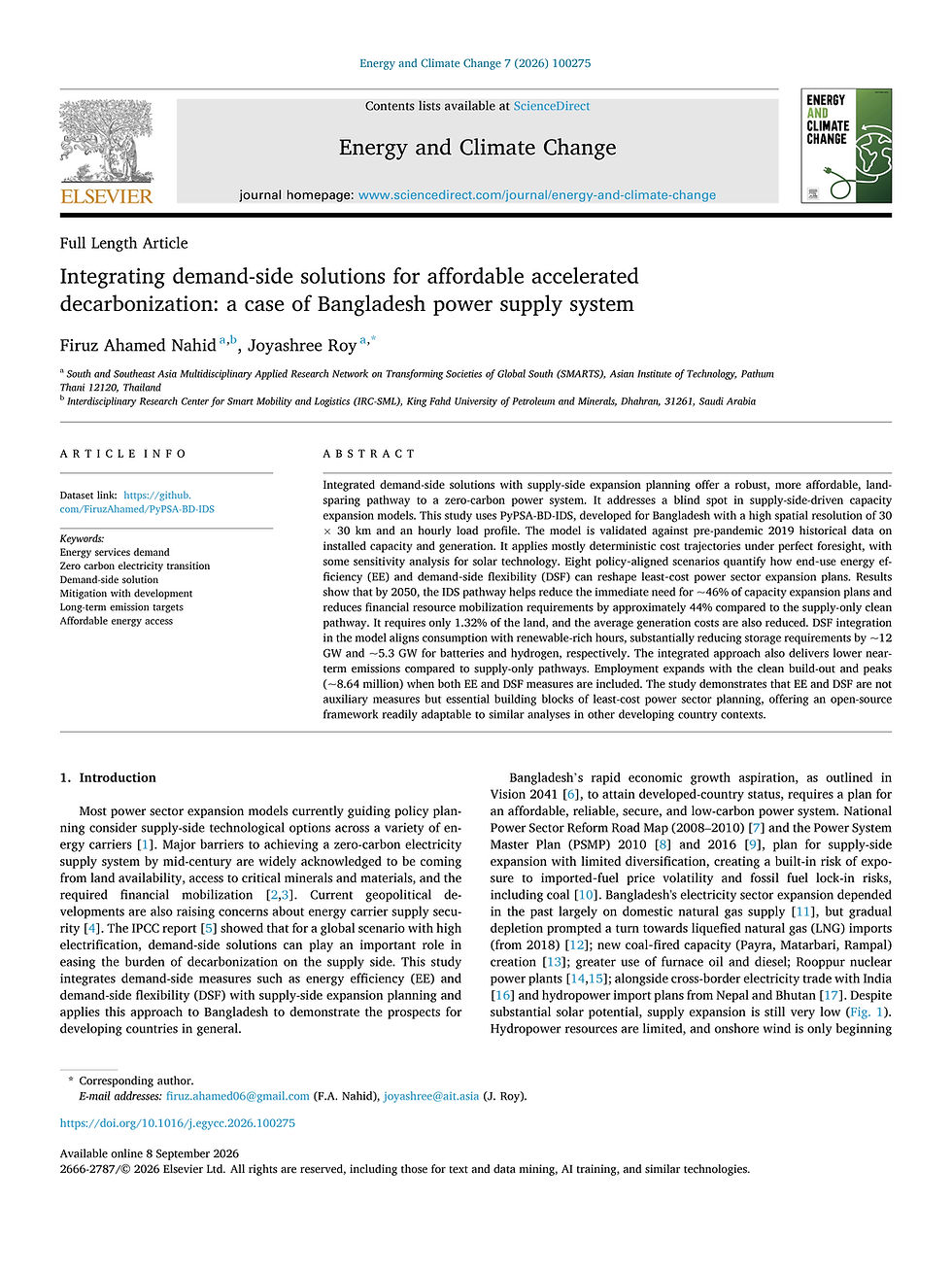
SMARTS's new publication: "Energy system modeling in South and Southeast Asia: Progress, gaps, and opportunities"

(https://doi.org/10.1016/j.egyr.2026.109377)

This paper presents the first systematic, PRISMA-based review of 97 peer-reviewed energy system modeling studies (2000–2025) across 15 South and Southeast Asian countries. It maps how nine core modeling frameworks — OSeMOSYS, LEAP, EnergyPLAN, TIMES, AIM, PyPSA, MESSAGEix, MARKAL, and IDEEA — have been applied across the region, and benchmarks their sectoral, temporal, spatial, and technological coverage against declared national climate pledges and NDCs.
The review consolidates fragmented evidence to reveal where modeling capacity has advanced, where it lags behind policy ambition, and where new research is most urgently needed to inform equitable and just transition pathways.
Find out:
⚡ Why models in the region are overwhelmingly electricity-sector focused, while transport, industry, buildings, construction, and mining remain underrepresented despite their rising carbon footprint.
🔋 Why long-duration storage (hydrogen, A-CAES, TES, PtG, flow & NaS batteries) and carbon removal options (CCS, CCUS, BECCS, ammonia) are barely represented — even as global deployment accelerates.
🌏 Why cross-border electricity trade — the ASEAN Power Grid, Greater Mekong Subregion, and emerging South Asian interconnections — is endogenized in only a handful of models, despite its proven cost, reliability, and decarbonization benefits.
🤝 Why demand-side flexibility, socioeconomic co-benefits, employment effects, health gains, and just-transition metrics must move from the margins to the core of regional energy modeling.
🛠️ Which countries lead in modeling exercises, and which urgently need stronger modeling capacity to support credible NDC 3.0 implementation.

Fig. 5. Representation of Low-Carbon Technologies in Energy System Models across South and Southeast Asia. The reviewed studies across South and Southeast Asia reveal a diverse but uneven representation of low-carbon technologies. Most models prioritize mature renewable options, particularly solar PV, onshore wind, hydropower, and biomass/biofuel technologies, which collectively form the backbone of decarbonization pathways in the region. However, a wider set of low‑carbon options is available, including geothermal, nuclear, and marine (wave/tidal) energy, yet these remain sparse in current modeling practice.
Read the article here now: https://doi.org/10.1016/j.egyr.2026.109377
Click here to find SMARTS' other publications: https://smartscenter.ait.ac.th/smarts-publications
#EnergySystemModeling #SouthAsia #SoutheastAsia #EnergyTransition #Decarbonization #LowCarbonPathways #ClimateJustice #JustTransition #CrossBorderPowerTrade #ASEANPowerGrid #DemandSideFlexibility #NDC #EnergySecurity #GlobalSouth #ClimateMitigation #RenewableEnergy #EDITS
Abishek Das
Firuz Ahmed Nahid
Joyashree Roy
Joyee S Chatterjee
Ninaad Desai
Nyi Min Satt Naing
Prathana Panwar
Sirayuth Thongprasert