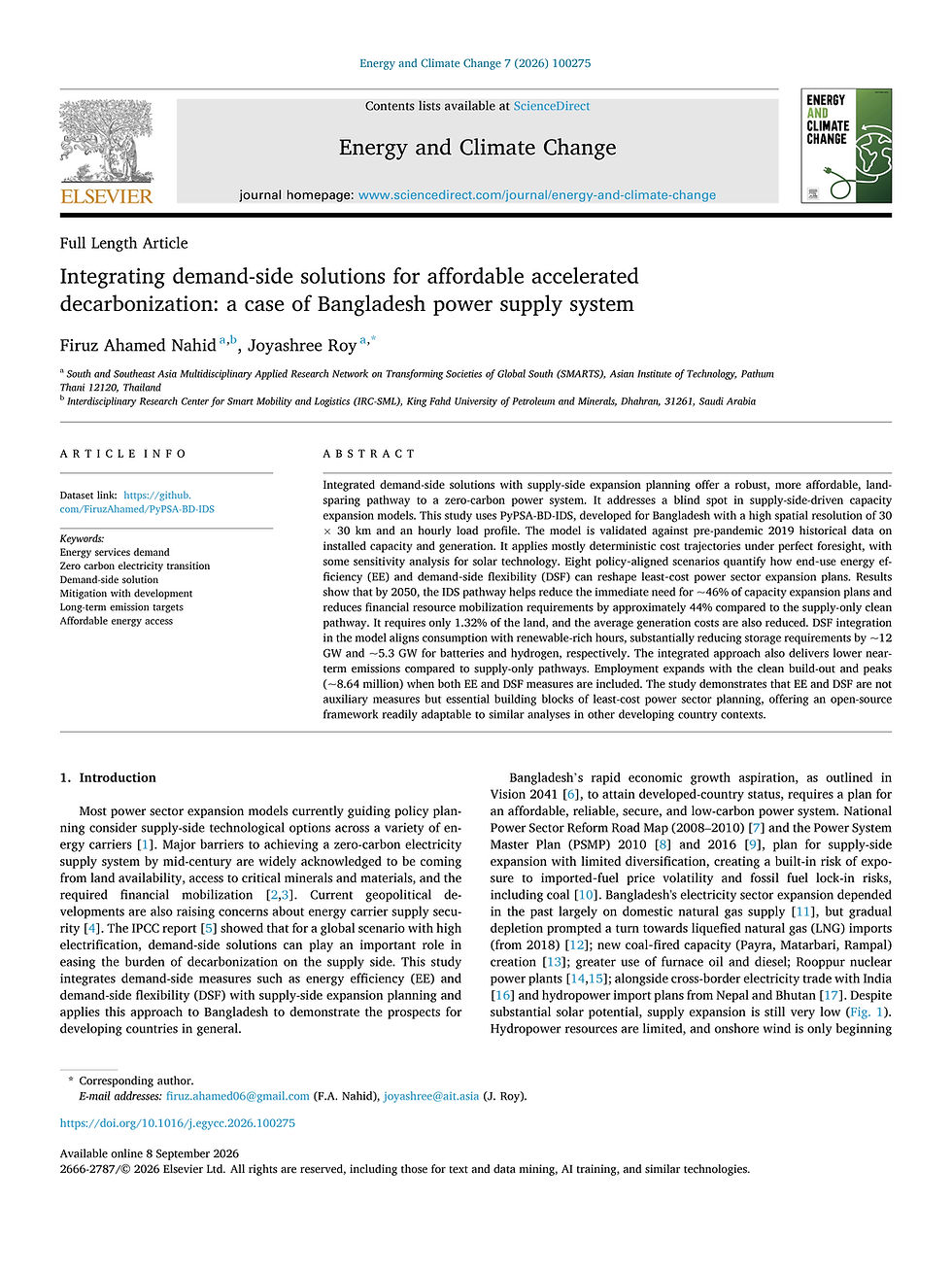
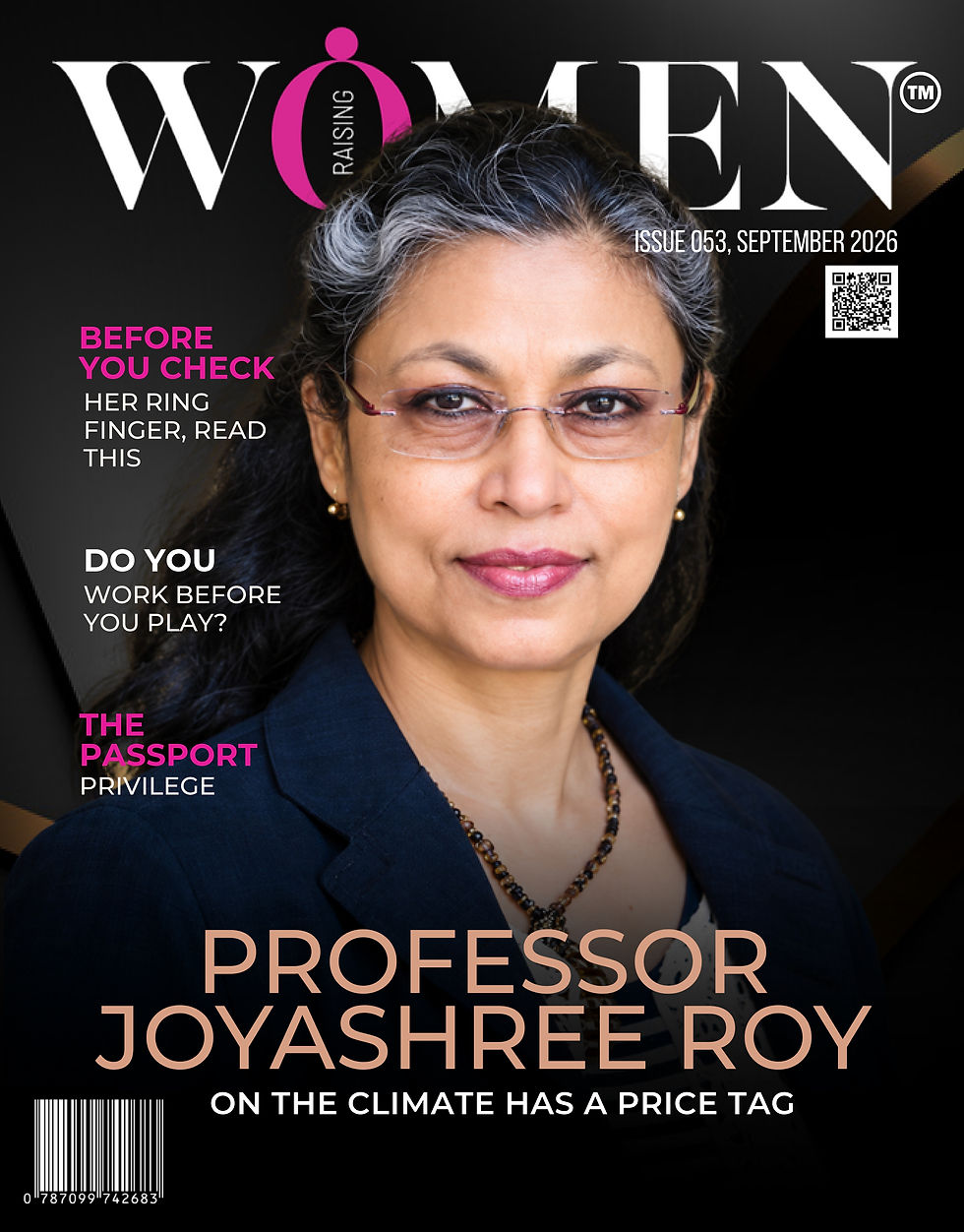
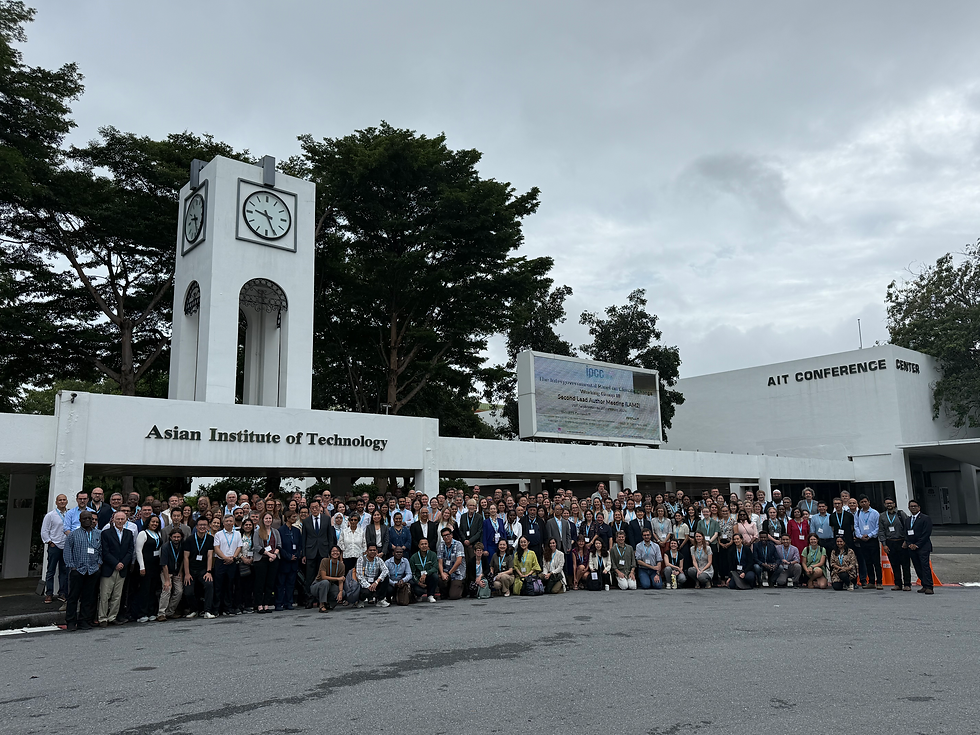
SMARTS's new publication: "Past trends, alternative futures, and energy demand scenarios for Bangladesh" (https://doi.org/10.1007/s11625-026-01833-9)

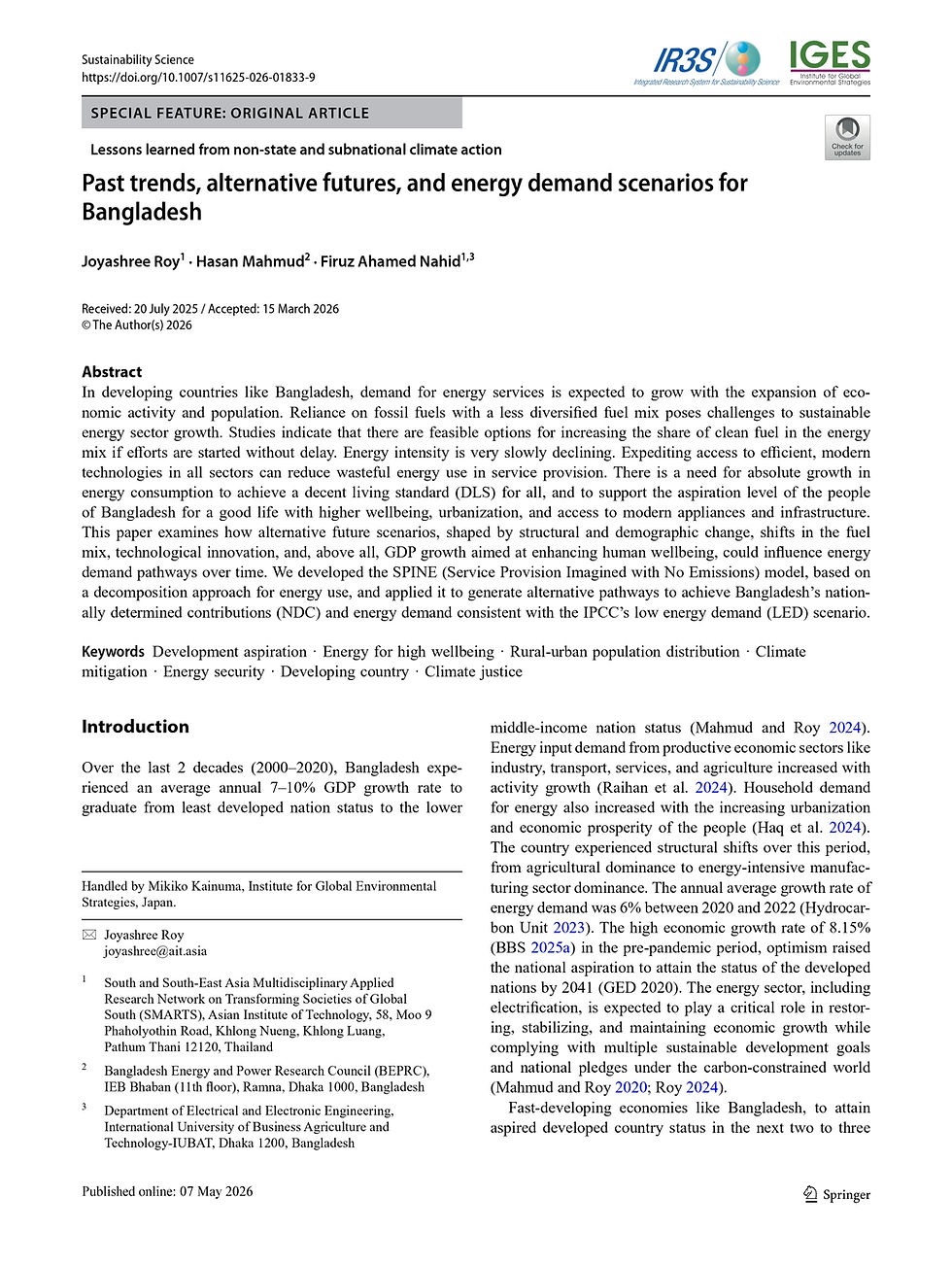
How can a fast-growing Global South economy meet its development aspirations, deliver Decent Living Standards (DLS) for all, and remain consistent with a 1.5°C pathway — without getting locked in the long-term high-carbon pathway or through over dependence on uncertain negative emission technologies?
This paper introduces the SPINE (Service Provision Imagined with No Emissions) model — SPINE-BD, the first application of this decomposition-based scenario framework, developed and applied here for Bangladesh. Building on the seminal Low Energy Demand (LED) scenario, SPINE-BD generates the first national-scale, LED- and DLS-consistent energy demand pathways for Bangladesh.
Using LMDI decomposition over the 2001–2018 pre-pandemic period and projections to 2030, the paper quantifies how structural change, fuel mix, energy intensity, urbanization, household expenditure, and GDP growth jointly shape primary energy demand — providing the policy-relevant waypoints needed for NDC 3.0 implementation, energy security planning, and just-transition design.
Find out:
⚡ How drivers of past energy use in Bangladesh explain the present, and what should be the new pathways for the next decade.
🌏 How five alternative scenarios (Defdem_noPol, Hwl_noPol, Defdem_1.5, Hwl_1.5, Hwl_1.5_DLS) produce different 2030 energy outcomes.
🏠 Why bridging the Decent Living Standard energy access gap demands only a modest additional energy supply — making basic need, climate justice, and 1.5°C alignment mutually achievable for a developing country.
🛠️ Which near-term policy levers — efficiency targets, structural shift toward services, low-carbon electrification, and human-capacity building — are decisive for avoiding stranded assets and "2035 cliff edge" lock-in.
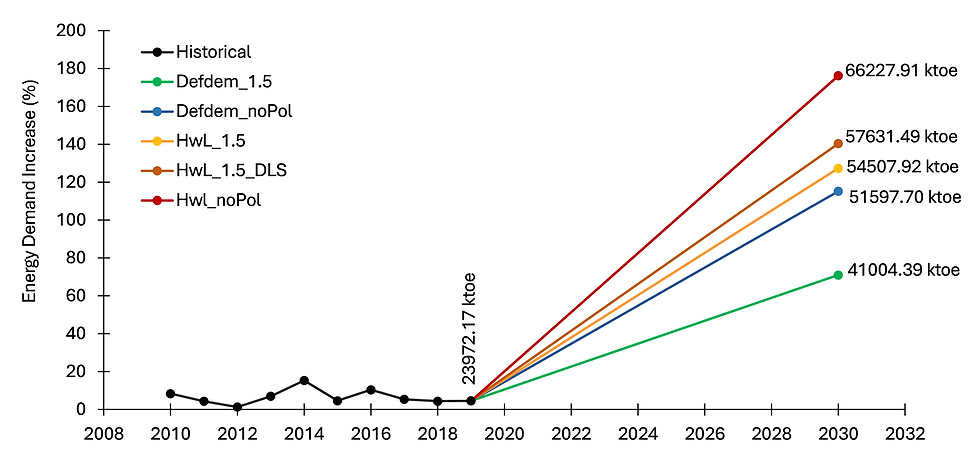
Fig. 9 Historical (per year from 2010 to 2019) and projected cumulative energy demand growth across future scenarios for the period 2019–2030 (compared to the 2019 baseline). The drivers of change are pushing the energy demand in a positive direction while providing a historical level of wellbeing on average to the people of Bangladesh.
Read the article here now: https://link.springer.com/article/10.1007/s11625-026-01833-9
Click here to find SMARTS' other publications: https://smartscenter.ait.ac.th/smarts-publications
#SPINEModel #LowEnergyDemand #LEDscenario #EDITS #DecentLivingStandards #ClimateJustice #EnergySecurity #DevelopingCountry #GlobalSouth #Bangladesh #ClimateMitigation #NDC #EnergyTransition #DevelopmentAspiration #HighWellbeing
The EDITS-AIT project (https://smartscenter.ait.ac.th/edits-ait) and the International Institute for Applied Systems Analysis (IIASA)
Abishek Das
Benigna Boza-Kiss
Firuz Ahmed Nahid
Hasan Mahmud
Joyashree Roy
Joyee S Chatterjee
Nyi Min Satt Naing
Prathana Panwar
Sirayuth Thongprasert