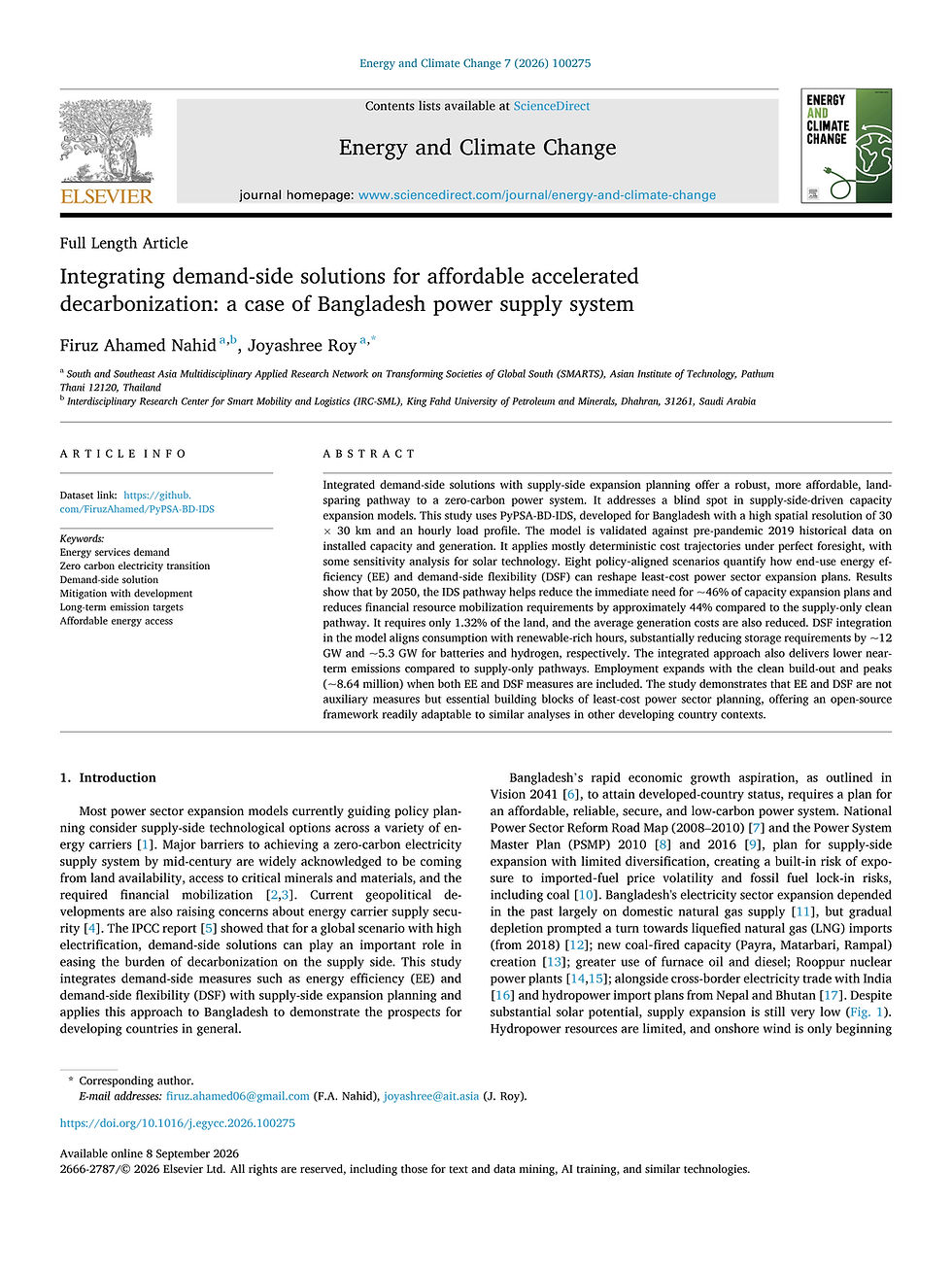
SMARTS's new publication: Planning for a Net-Zero Future: Evolution of Electricity System Models


A new publication co-authored by Abhishek Das in the Annual Review of Environment and Resources: “Planning for a Net-Zero Future: Evolution of Electricity System Models”
This review traces how electricity system planning models have evolved from conventional capacity-expansion tools to more complex decision-support systems for net-zero transitions. It reflects how models are increasingly expected to inform not only least-cost generation choices, but also flexibility, demand response, renewable integration, open-source planning, socioeconomic impacts, and just-transition concerns.
Three key takeaways:
⚡ Net-zero planning is no longer only about adding renewables. High renewable shares require flexibility, storage, transmission planning, demand-side management, and robust treatment of variability and uncertainty.
🌏 Models are becoming central to climate and development decisions.
As electricity systems become more capital-intensive, multi-sectoral, and policy-driven, transparent and context-sensitive modelling becomes essential for public planning and investment decisions.
🤝 The next frontier is social and economic realism.
Future models must shift focus to justice, equity, public acceptance, behavioural change, stranded assets, and regional transition impacts, especially in developing-country contexts.
The broader message is simple: electricity models are not just technical tools. They are increasingly becoming platforms for negotiating the future of energy, development, and justice.
The attached figure schematically shows how energy systems are shifting from conventional, centralized architectures to complex, multi-technology, net-zero-oriented systems driven by climate concerns, rising system complexity, and the need for evidence-based planning. Electricity system models are therefore becoming essential tools for integrating renewables, demand response, smart grids, and multi-sector interactions, with open-source approaches offering greater transparency, reproducibility, and stakeholder participation than costlier and less transparent proprietary tools.

#NetZero #EnergyTransition #ElectricityPlanning #RenewableEnergy #OpenSourceModels #JustTransition #EnergyPolicy #ClimateAction